Putting the A in STEM: How Art Fits Into “STEAM”
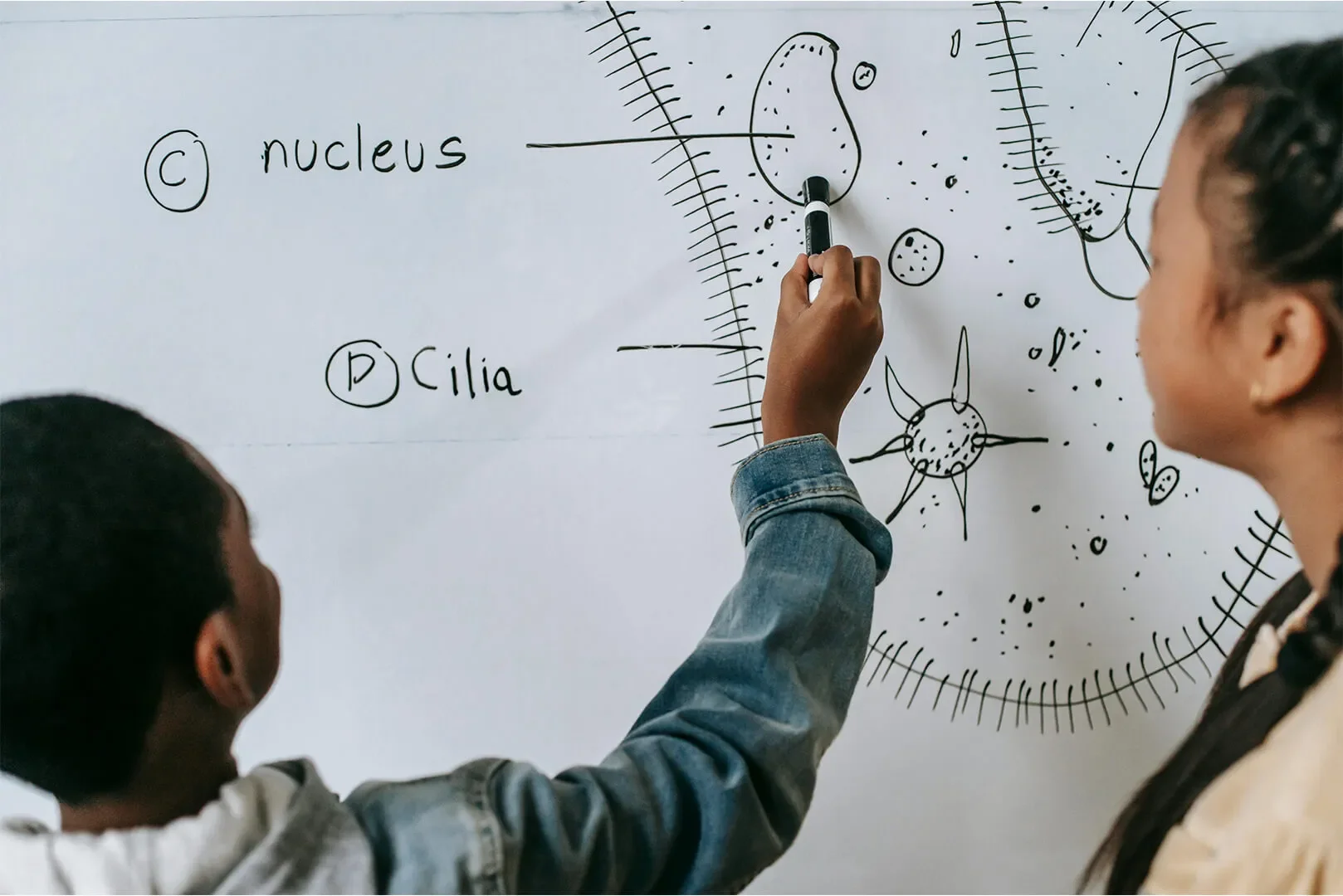
If STEM is the toolkit, STEAM is the toolkit plus the creative process.
Because in real life, breakthroughs are not only technical. They are also visual, human, iterative, and communicable. That is where the “A” matters.
STEM vs. STEAM (quickly)
STEM focuses on science, technology, engineering, and math.
STEAM adds art and design to strengthen how students observe, prototype, problem-solve, and communicate. It is not “make it pretty at the end.” It is using creative thinking as part of the build and process.
What the “A” actually adds
1) Better observation, better questions
Art trains attention. Kids learn to notice shape, pattern, texture, contrast, and change, which feeds science directly. When students see more, they ask better questions.
2) Visual thinking that makes complex ideas clearer
Scientists and engineers rely on diagrams, models, and visualizations. Visual literacy is not a bonus skill in science learning, it is foundational to how we understand and communicate scientific ideas.
If you want a simple classroom example: have kids draw what they think is happening in a process before they explain it. The drawing reveals the thinking.
3) Iteration without fear
Art normalizes drafts. Try, revise, try again. That mindset is basically engineering.
STEAM projects often create a safer runway for experimentation because kids are allowed to change the plan without feeling like they “failed.”
4) Communication people can actually understand
A good solution is not useful if you cannot explain it. Art and design help students present ideas with clarity, using visuals and storytelling instead of only technical language.

What research and evidence say
Arts integration and STEAM are studied in different ways across schools, so evidence varies by program, age group, and implementation. Still, there is meaningful support for the idea that integrating arts can strengthen learning outcomes and engagement.
The National Academies describes emerging evidence that integrating arts and humanities with STEM is linked with positive learning outcomes and skills that matter beyond school.
A 2016 study (Graham & Brouillette, Journal for Learning through the Arts) found that grades 3–5 students who received arts-integrated physical science lessons showed greater gains on district benchmarks than students in a STEM-only curriculum, suggesting arts methods (drawing, movement, drama) can give concrete-thinking students tools to “envision” phenomena they cannot directly observe, which is a common bottleneck in physical science learning at that age.
A local note
San Diego schools and educators are part of a broader shift toward STEAM because it supports creative problem-solving and more engaged learning. Here’s a quick, snapshot of how local educators explain STEAM, the University of San Diego published an educator-facing guide that frames STEAM as project-based learning across Science, Technology, Engineering, Arts, and Math, with an emphasis on helping students learn how to ask questions, experiment, create, and communicate.
One line from the piece says it plainly: “There is a dynamic synergy between the visual arts and the natural sciences.”
Simple ways to “STEAM-ify” any project
If you want a practical structure that works for classrooms, libraries, or home projects:
Notice → Sketch → Build → Test → Share
Notice: what stands out, what repeats, what changes
Sketch: plan a first version, even rough
Build: make it quickly, do not overthink
Test: what worked, what did not, why
Share: explain the process with visuals
That framework turns “art” into a thinking tool, not an add-on.
Where this lands for Palette of Possibilities
We care about and integrate STEAM because it teaches the habits behind innovation: observation, prototyping, revision, and communication. When kids can sketch an idea, test it, and change course, they are doing real STEAM thinking.
Art does not compete with STEM. It strengthens it by making learning visible and experimentation normal.